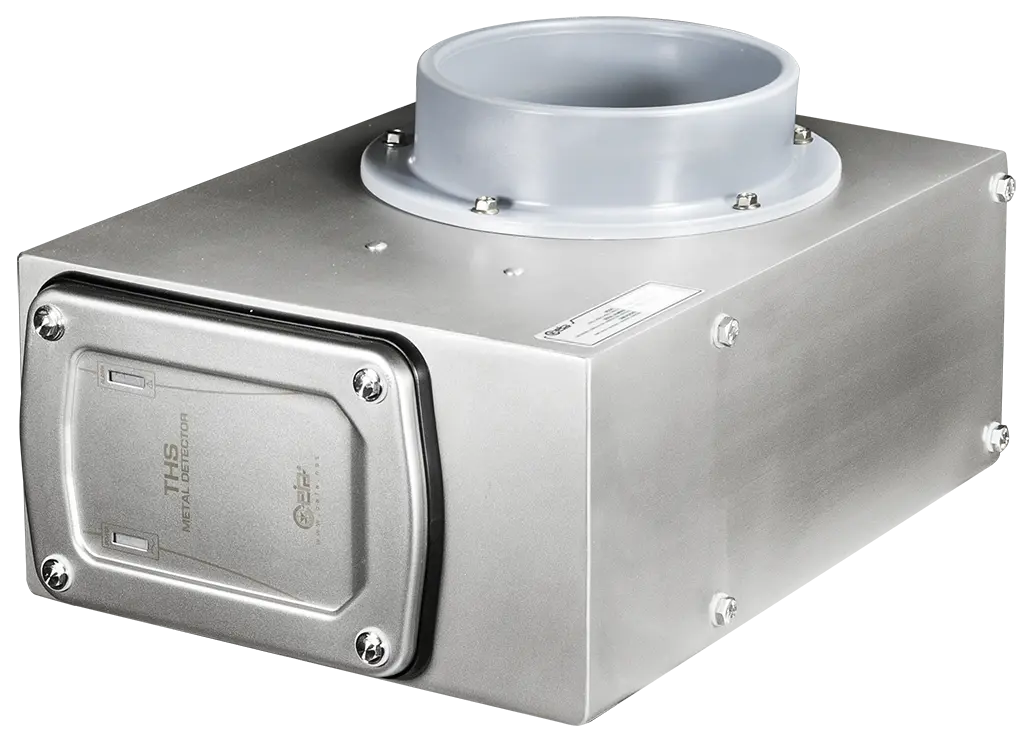
The highly integrable solution for the inspection of powders and granules. Thanks to digital signal analysis, it offers an exclusive detection capability for magnetic and non-magnetic metals, including stainless steel. Constructed from AISI 316L stainless steel, it withstands high-pressure washdown and ensures full compliance with FDA 21CFR Part 11 regulations. Its extreme speed allows it to divert contaminants without slowing down the production flow, ensuring maximum safety, integrity, and operational traceability.
- Home
- Cereals, Pet Food, Granules and Powders
Cereals, Pet Food, Granules and Powders
CEIA metal detectors guarantee maximum food safety in the inspection of cereals, pet food, granules, and powders. Ideal for dry and bulk products, THS systems offer ultra-high sensitivity even for the smallest contaminants. Thanks to gravity fall solutions with rapid deflector valves, conveyor systems, and ATEX-certified versions for explosive atmospheres, CEIA eliminates waste and protects process machinery.

Detecting Metallic Contaminants in Cereals, Pet Food, Granules & Powders Production
Ensuring the absence of physical contaminants is a fundamental requirement for food safety in the production of cereals, pet food, granules, and powders. Among potential hazards, metallic contamination represents one of the most critical risks that must be effectively controlled. Metal fragments can originate from processing equipment, milling systems, conveying lines, or packaging operations, making advanced detection technologies essential to protect consumers and ensure product quality.
Sources of Metal Contamination
In cereals, pet food, granules, and powder processing, production typically involves operations such as milling, grinding, mixing, drying, and pneumatic or mechanical conveying. Over time, the normal wear and tear of mills, crushers, mixers, screw conveyors, and pneumatic transport systems can lead to the release of small metal particles. Additionally, raw materials may introduce contaminants from upstream agricultural or handling processes.
Due to the fine and free-flowing nature of these products, metal contaminants are often difficult to detect visually. For this reason, automated inspection systems are essential to identify and remove contaminated product before it reaches downstream processing stages or final packaging.
Metal detection can be implemented at multiple points along the production process, depending on product characteristics and plant layout.
Gravity-fed systems are the most common solution for cereals, pet food, granules, and powders, as they are ideal for vertical product flows such as bulk materials, flours, sugars, grains, and similar products. In these configurations, the product passes through the detector by gravity, ensuring a consistent flow and enabling very high detection sensitivity. In the event of contamination, fast-acting rejection systems—such as diverter valves—automatically remove the affected product stream with minimal product loss (THS/FFV21 series). Alternatively, the system can stop the process to allow manual inspection and removal (THS/G21 series).
Conveyor-based systems may be used for bagged or packaged products, as well as for products transported horizontally. These systems integrate a metal detector with a conveyor and an automatic rejection device, such as an air blast or pusher, ensuring that finished products comply with safety standards before leaving the facility.
The selection of the appropriate inspection solution depends on factors such as product bulk density, flow characteristics, installation point, and required sensitivity levels. In many cases, a combination of inspection systems is used at different critical control points to ensure maximum protection.
In addition to safeguarding product quality, metal detection systems play a key role in protecting processing equipment. Early detection of metallic contaminants helps prevent damage to sensitive machinery such as mills, sifters, and packaging equipment, ensuring operational continuity and reducing maintenance costs.

Challenges in Cereals, Granules and Powders Processing Environments
Detecting metal contaminants in Cereals, Pet Food, Granules and Powders Processing Environments presents specific technical challenges.
CEIA offers both entry-level metal detection solutions (THS/21ET) and the most advanced technologies on the market (THS/21), capable of detecting even the smallest metallic contaminants on dry neutral products.
Periodic testing of the metal detector with certified test samples by operators is also an aspect that must be considered, due to the time required to perform this activity, especially in applications involving multi-head weighers and bagmakers: CEIA AUTO-QC™ TEST provides a digital and effective calibration check along with a 0÷100% programmable reduction of the manual verifications, resulting in a corresponding reduction of labour cost, accidental product contamination and product waste.
CEIA Metal Detectors are available also in ATEX-compliant configurations, ensuring safe and reliable operation in hazardous environments with potentially explosive atmospheres.